AI Audiobook Narration vs. Human Narrator
Compare AI audiobook narration with human narrators to understand the differences in cost, production time, vocal expression, and creative control before choosing the right option for your book.
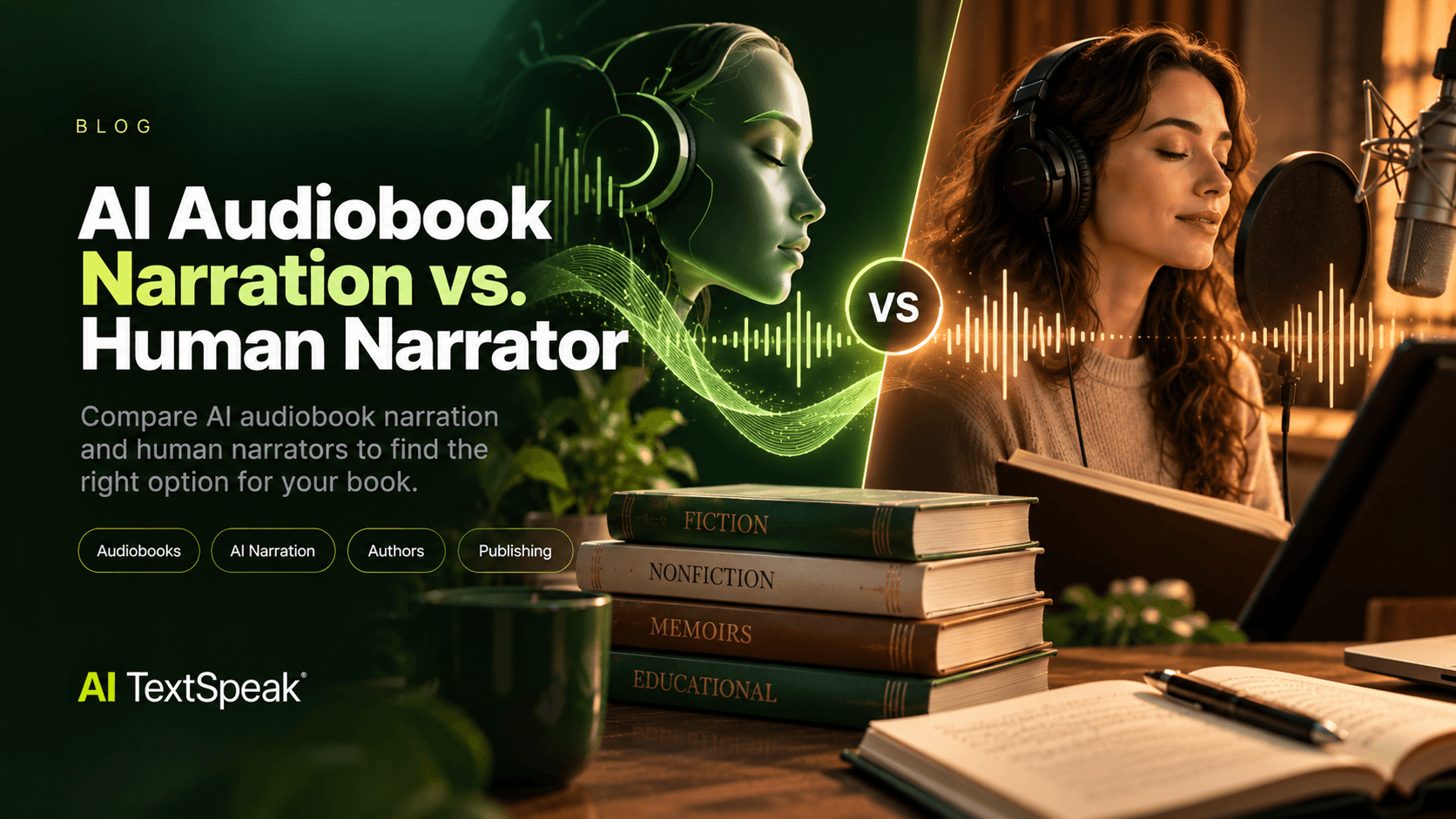
Choosing how to narrate an audiobook is an important decision for authors and publishers. A human narrator can bring a story to life through interpretation, character development, and emotional nuance. AI audiobook narration offers a different approach, using text-to-speech technology to turn written content into spoken audio.
So, which option is better: AI audiobook narration or a human narrator?
The answer depends on your book, budget, production timeline, audience expectations, and publishing goals. This guide compares both approaches so you can make an informed decision.
AI Audiobook Narration vs. Human Narrator: Quick Comparison
| Factor | AI Audiobook Narration | Human Narrator |
|---|---|---|
| Production process | Speech is generated from written text using an AI voice. | A narrator performs the text, usually followed by audio editing. |
| Emotional interpretation | Depends on the voice model and available controls. | Can offer nuanced acting, character interpretation, and intentional emotional shifts. |
| Consistency | Can maintain a consistent synthetic voice across sections. | Depends on performance, recording conditions, and production direction. |
| Revisions | Individual passages may be regenerated after adjustments. | Changes may require additional recording and editing. |
| Creative direction | Limited to the tool's available voices and controls. | Allows collaboration with a performer and direction of delivery. |
| Costs | May reduce recording costs, depending on usage, editing, and licensing requirements. | May involve narration fees, studio work, editing, and other production expenses. |
| Best suited for | Projects that prioritize flexible production and synthetic narration. | Projects that depend on performance, character acting, or a distinctive human interpretation. |
These differences are general guidelines rather than guarantees. Results depend on the narration tool, the individual narrator, the manuscript, and the requirements of your intended distribution channel.
What Is AI Audiobook Narration?
AI audiobook narration uses text-to-speech (TTS) technology to convert written content into spoken audio. Depending on the tool, users may be able to select a voice, choose a language or accent, adjust available settings, and generate audio from sections of a manuscript.
This approach can be useful for authors, educators, independent publishers, and content creators who want to explore audio versions of their written work.
However, AI narration still requires preparation and quality control. Pronunciation, pacing, pauses, and the interpretation of complex passages should be reviewed before the audio is published.
What Does a Human Audiobook Narrator Offer?
A human narrator interprets the manuscript and performs it for listeners. Depending on their experience and the direction they receive, they can adjust emphasis, pacing, tone, character voices, and emotional delivery throughout the book.
Human narration can be particularly valuable when a book depends on subtle character distinctions, dramatic tension, humor, emotional complexity, or a recognizable performance style.
Hiring a narrator may also involve more coordination. Authors and publishers may need to audition talent, agree on a performance style, schedule recording sessions, review samples, and manage revisions and audio production.
1. Voice Quality and Emotional Expression
Voice quality is one of the most noticeable differences between AI and human narration. Both approaches can produce clear, understandable speech, but they do not necessarily deliver the same listening experience.
When AI narration works well
- Nonfiction books with a clear, straightforward writing style.
- Educational material where clarity and consistency are priorities.
- Reference content and practical guides.
- Projects where a suitable synthetic voice meets the intended audience's expectations.
When a human narrator may be preferable
- Fiction that relies on distinctive character performances.
- Memoirs where personal delivery and emotional nuance are central.
- Comedy, suspense, or drama that depends on precise timing.
- Books where the author wants a specific performance or established narrator.
These are not absolute rules. Some nonfiction benefits from expressive human narration, and some projects may work well with AI voices. The best way to evaluate either option is to listen to a representative passage from your actual manuscript.
2. Production Time and Workflow
AI narration can simplify the process of generating speech because it does not require a narrator to record every line. Depending on the platform, text length limits, and available features, authors may be able to generate audio in sections and revise individual passages when needed.
Nevertheless, generating audio is only one part of audiobook production. Manuscript preparation, pronunciation checks, audio review, file organization, and final quality control still take time.
Human narration typically requires auditioning or selecting a narrator, coordinating recording, reviewing performances, and completing any necessary revisions. The timeline varies according to the book's length, the narrator's availability, and the complexity of the production.
Practical recommendation: Test one representative chapter using your preferred AI voice or a human narrator's sample. Compare not only the recording time, but also the time needed for revisions and final approval.
3. Cost: AI Narration vs. Human Narration
Cost is often a major consideration for independent authors and publishers. However, comparing only the initial generation fee with a narrator's quote can lead to an incomplete picture.
When evaluating AI narration, consider:
- Subscription or usage-based fees.
- Text or audio generation limits.
- Time spent preparing the manuscript and correcting pronunciation.
- Audio editing, assembly, and quality assurance.
- Licensing terms for commercial use.
For human narration, consider:
- The narrator's fee and the pricing structure used.
- Studio recording and audio engineering, if applicable.
- Editing, mastering, and file preparation.
- Additional recording sessions or revisions.
- Any contractual rights, royalties, or distribution arrangements.
AI narration may be less expensive for some projects, but savings depend on the tool, production requirements, and amount of human review needed. A human narrator may justify a higher investment when the performance adds meaningful value to the final product.
4. Creative Control and Consistency
Consistency matters when listeners spend several hours with an audiobook. Sudden changes in tone, volume, pacing, or character interpretation can interrupt the experience.
AI narration can help maintain a consistent synthetic voice across sections, provided the tool and settings support the intended workflow. Authors should still check transitions, pronunciation, and pacing from chapter to chapter.
A human narrator can interpret the story more dynamically and respond to creative direction. However, maintaining consistency across a long project requires careful recording, performance direction, and editing.
Before choosing either approach, identify what matters most for your book: uniform delivery, expressive interpretation, flexibility during revisions, or a particular artistic vision.
5. Publishing Requirements and Commercial Rights
Before investing in narration, check the requirements of your intended audiobook distributor or publisher. Some platforms may have specific rules concerning synthetic voices, AI-generated content, disclosure, audio specifications, or eligibility for distribution.
You should also review the applicable contract and license terms. Confirm whether the voice and tool may be used for commercial projects, whether there are restrictions on redistribution, and whether additional permissions are required.
Do not assume that every AI voice includes unrestricted commercial rights or that every distribution platform accepts every type of AI-narrated audiobook. Requirements can vary and may change over time.
Which Option Is Better for Your Book?
Use the following guide as a starting point when deciding between AI narration and a human narrator.
Choose AI narration if:
- You want to explore a flexible text-to-speech workflow.
- Your book works well with clear, consistent spoken delivery.
- You are comfortable reviewing and correcting generated audio.
- The available voice, licensing terms, and distribution rules fit your project.
Consider a human narrator if:
- Your book relies heavily on character acting or dramatic interpretation.
- You want a distinctive performance tailored to your manuscript.
- Your audience expects a particular narration style or established voice.
- You have a budget and timeline that support professional recording and production.
Consider a hybrid workflow
Some creators may benefit from using different approaches at different stages. For example, AI-generated audio can help authors review how a manuscript sounds aloud during development, while a human narrator may be selected for the final commercial edition.
Whether this approach makes sense depends on the intended use, available tools, and publishing requirements. Always verify the relevant rights and rules before distributing the final audio.
How to Test AI Narration Before Committing
If you are considering AI narration, do not evaluate a voice using only a single short sentence. Use a passage that represents the language, structure, and tone of your book.
- Prepare a sample: Choose a passage that includes typical sentences, punctuation, and any specialized vocabulary.
- Try an appropriate voice: Select a language, accent, and tone that fit your audience.
- Listen critically: Check pronunciation, pacing, clarity, and whether the delivery feels appropriate.
- Compare alternatives: Listen to the same passage using different available voices.
- Review the workflow: Consider how easily you can correct mistakes and produce consistent sections.
AI TextSpeak lets you explore AI text-to-speech voices for written content. You can test a sample of your manuscript and assess whether the available narration style fits your project before planning a larger workflow.
Try AI TextSpeak to explore AI-generated speech for your book.
Frequently Asked Questions
Is AI narration good enough for an audiobook?
It can be suitable for some projects, depending on the voice quality, manuscript, audience expectations, and distribution requirements. Always listen to representative samples and review the complete audio before publishing.
Is AI audiobook narration cheaper than hiring a narrator?
It may be less expensive for some projects, but total costs depend on subscription or usage fees, editing, quality assurance, licensing, and production needs. Compare the full workflow rather than only the initial price.
Can AI narration convey emotion?
Some AI voices can convey aspects of tone and expression, depending on the technology and available controls. However, their ability to interpret subtle emotions and complex character performances varies. Test the actual passages that matter most to your book.
Can I publish an AI-narrated audiobook commercially?
That depends on the tool's license, the rights associated with your content and voice selection, and the rules of your intended distributor. Review current terms and disclosure requirements before publishing.
Should I use AI narration for fiction or nonfiction?
Either may work, but the right choice depends on the book. Nonfiction with straightforward delivery may be a good candidate for AI narration, while fiction with complex characters may benefit from a skilled human performance. Test your manuscript before deciding.
Final Thoughts
AI audiobook narration and human narration offer different advantages. AI can provide a flexible way to generate spoken content, while human narrators can bring performance, interpretation, and emotional nuance to a book.
The right choice depends on your manuscript, your audience, your budget, and your publishing goals. Compare realistic samples, account for the full production workflow, and verify the relevant licensing and distribution requirements before committing.
If you want to explore synthetic narration, try AI TextSpeak and see how your written content sounds with an AI voice.