Best AI Voices for E-Learning
Discover the best AI voice styles for e-learning and learn how to choose clear, natural, professional voices for online courses, tutorials, and training.
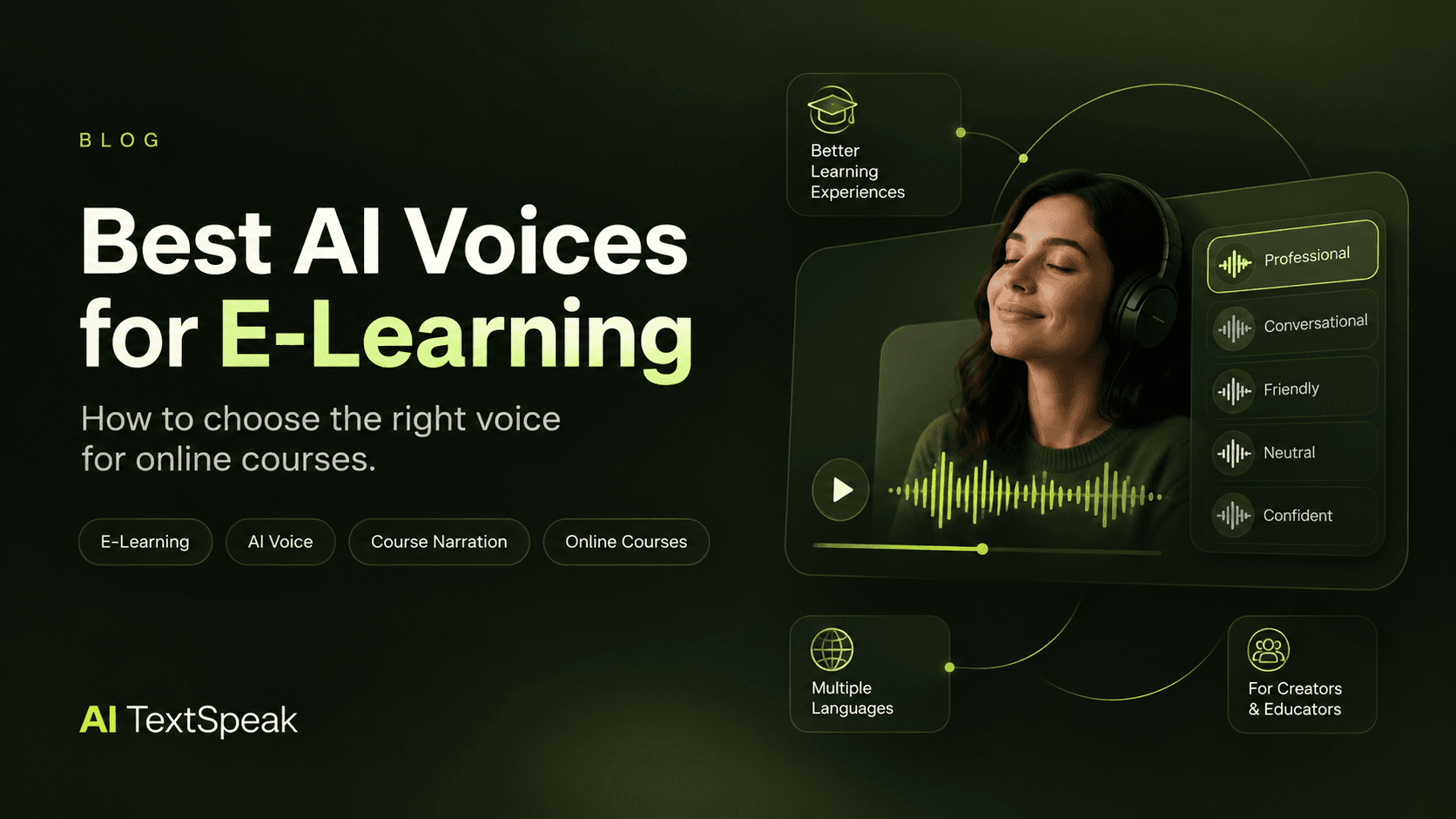
Choosing the right AI voice for an e-learning course is about more than finding a voice that sounds realistic. The best voice should be clear enough to understand, natural enough to listen to for long periods, and appropriate for the subject and audience.
A voice that works well for a short social media video may become distracting during a 30-minute training module. For e-learning, clarity, pacing, consistency, and tone matter just as much as realism.
In this guide, we’ll look at the best AI voice styles for e-learning, which types of courses they work best for, and how to choose the right voice before producing your full course.
What Makes an AI Voice Good for E-Learning?
E-learning narration has different requirements from advertising, entertainment, or short-form content. Learners may listen to the same voice across dozens of lessons, sometimes while reading slides, taking notes, or following instructions.
The best AI voice for e-learning should have several qualities:
- Clarity: Words, numbers, technical terms, and instructions should be easy to understand.
- Natural pacing: The voice should give learners enough time to process information without sounding unnecessarily slow.
- Consistent delivery: The voice should sound reliable across lessons and modules.
- Natural pronunciation: Names, acronyms, industry terms, and specialized vocabulary should be pronounced correctly.
- Appropriate tone: The voice should match the subject, audience, and learning environment.
- Long-form comfort: A voice that sounds impressive for 30 seconds should still be comfortable to hear for 20 or 30 minutes.
In other words, the best e-learning voice is not necessarily the most dramatic voice. It is the one that helps learners focus on the material instead of the narration.
The Best AI Voice Styles for E-Learning
There is no single voice that is perfect for every course. Different subjects and audiences call for different delivery styles.
Here are the most useful AI voice styles for e-learning.
1. Clear Professional Voice
A clear professional voice is one of the safest choices for online learning. It communicates information confidently without sounding overly theatrical or casual.
This style works particularly well for:
- Corporate training
- Compliance courses
- Professional development
- Business education
- Workplace onboarding
For professional training, prioritize precise pronunciation, moderate pacing, and a confident delivery. The goal is to sound knowledgeable without becoming overly formal.
2. Warm Conversational Voice
A conversational voice can make educational content feel more approachable. Instead of sounding like someone reading a textbook, the narrator should feel more like an instructor explaining an idea directly to the learner.
This style is especially useful for:
- Coaching programs
- Personal development courses
- Customer education
- Online creator courses
- Storytelling-based lessons
A conversational voice can increase engagement, but avoid choosing one that is so expressive that it distracts from the lesson.
3. Neutral Instructor Voice
For technical, academic, or information-heavy content, a neutral instructor voice can be an excellent choice.
The delivery should be steady, articulate, and easy to follow. This makes it easier for learners to concentrate on definitions, processes, examples, and instructions.
Consider this style for:
- University courses
- Technical training
- Software tutorials
- Certification programs
- Research-based educational content
When the material is complex, clarity should come before personality.
4. Confident Expert Voice
Some courses require a stronger sense of authority. A confident expert voice can help establish credibility when the narrator is explaining specialized or professional subject matter.
This style can work well for:
- Leadership training
- Business courses
- Technology education
- Finance and entrepreneurship
- Professional certifications
The key is balance. The voice should communicate expertise without sounding aggressive, overly promotional, or difficult to listen to.
5. Friendly Educational Voice
Courses aimed at beginners often benefit from a friendly and encouraging voice. This is particularly useful when the learner may already feel uncertain about the subject.
A friendly voice can work well for:
- Beginner courses
- Introductory tutorials
- Language learning
- General education
- Student-focused content
The voice should feel supportive without becoming overly energetic or childish. The right level of warmth depends on the age and expectations of the audience.
6. Multilingual AI Voice
If your course is intended for an international audience, language support becomes another important part of voice selection.
A strong multilingual workflow allows you to adapt the same course into multiple languages while maintaining a consistent style and learner experience.
When evaluating multilingual voices, look beyond the number of languages available. Pay attention to pronunciation, natural pacing, and whether the voice continues to sound appropriate in each language.
Best AI Voices for Different Types of E-Learning
The right voice depends heavily on what you are teaching. Here is a simple starting point:
| Course Type | Recommended Voice Style | Why It Works |
|---|---|---|
| Corporate training | Clear and professional | Builds credibility and keeps information easy to follow. |
| Compliance training | Neutral and precise | Keeps attention on rules, procedures, and important details. |
| Software tutorials | Calm and instructional | Gives learners time to follow each step. |
| Academic courses | Neutral and authoritative | Supports information-heavy and technical material. |
| Language learning | Clear and expressive | Helps learners pay attention to pronunciation and speech patterns. |
| Leadership training | Confident and conversational | Creates a more personal and engaging learning experience. |
| Beginner courses | Friendly and encouraging | Makes unfamiliar subjects feel more approachable. |
| International courses | Natural multilingual voice | Supports localization while maintaining a consistent course experience. |
How to Choose the Right AI Voice for Your Course
Before selecting a voice, start with the learning experience you want to create.
1. Identify Your Audience
Consider who will actually listen to the course. A voice designed for executives may not be appropriate for teenagers, while a highly energetic educational voice may feel out of place in compliance training.
Think about the learner's age, professional background, familiarity with the subject, and reason for taking the course.
2. Match the Tone to the Subject
The tone should support the material rather than compete with it.
A serious compliance course generally benefits from a calm and professional delivery. A creative course may have more room for warmth and personality.
3. Prioritize Clarity Over Character
It is easy to choose a voice because it sounds impressive in a short demo. But e-learning is a long-form listening experience.
Ask yourself whether the voice remains clear and comfortable when reading several paragraphs of instructional content.
4. Test Pronunciation
Use real course material when testing a voice. Include the words that are most likely to cause problems, such as technical terminology, acronyms, names, numbers, and industry-specific language.
A voice can sound excellent in a generic demo and still struggle with the vocabulary your course actually uses.
5. Test Longer Samples
Do not make your decision based on a single sentence.
Generate a longer sample using a real section of your course. Listen for changes in rhythm, awkward pauses, repetitive patterns, or moments where the voice becomes tiring.
6. Think About Consistency
If one voice will narrate dozens of lessons, consistency matters enormously. The voice should work across introductions, explanations, examples, transitions, and conclusions.
Choosing a voice that only works for one type of sentence can create problems later in production.
Why Voice Consistency Matters in E-Learning
Imagine starting a course with one narrator and suddenly switching to a completely different voice halfway through the program.
Even if both voices sound good individually, the change can make the course feel less cohesive.
Consistency helps create a recognizable learning environment. Ideally, learners should be able to move from one lesson to the next without feeling like the production quality has changed.
AI voice technology can be particularly useful here because the same selected voice can be used repeatedly without the variations that naturally occur between different recording sessions.
Should You Choose a Male or Female AI Voice?
There is no universal answer. Gender should not be the main criterion for choosing an e-learning voice.
Instead, focus on the characteristics that directly affect the learning experience: clarity, tone, pacing, pronunciation, and suitability for the audience.
The best approach is to test several voices with the same piece of course content and compare how each one feels in context.
AI Voice vs. Human Voice for E-Learning
Human narration still has advantages, particularly when a course depends heavily on a specific instructor's personality, performance, or personal connection with the audience.
AI narration, however, can be especially useful when speed, consistency, scalability, or frequent updates are important.
For example, imagine a training course that changes every few months. With traditional narration, even a small script update may require another recording session. With AI narration, the revised section can be generated again using the same voice.
The right choice depends on the course, audience, budget, production schedule, and how often the content changes.
How to Test an AI Voice Before Producing Your Full Course
Before generating every lesson, create a short voice test using real course content.
A useful test should include:
- A short introduction
- A technical or specialized term
- A number or statistic
- A question
- A longer explanatory paragraph
- A transition between concepts
- A call to action or learner instruction
Then listen to the sample at the speed your learners are likely to use.
Do not only listen through studio headphones. Test the narration on the devices your audience is likely to use, such as laptop speakers, phones, or headphones.
The goal is not to find the voice that sounds most impressive in isolation. It is to find the voice that remains clear and comfortable when used in the real learning environment.
Best Practices for Using AI Voices in E-Learning
- Write for listening: Course scripts should sound natural when spoken, not like written essays.
- Use intentional pauses: Give learners time to process important concepts.
- Keep pronunciation consistent: Pay special attention to technical terms and acronyms.
- Use one primary narrator: Maintain consistency across lessons whenever possible.
- Review every generated section: Always listen to the final audio before publishing.
- Use captions and transcripts: Provide alternative ways for learners to access the information.
- Test before scaling: Approve the voice and delivery style before generating an entire course.
Can AI Text-to-Speech Work for Professional E-Learning?
Yes. Modern AI text-to-speech can be a practical option for professional courses, corporate training, tutorials, and other educational content when the voice is selected carefully and the generated narration is reviewed before publication.
The technology is most useful when it solves a real production problem: creating narration faster, maintaining consistency, updating lessons efficiently, or expanding a course to new languages.
For commercial courses and professional training, always review the licensing and usage terms of the AI voice service and plan you choose before publishing the content.
Frequently Asked Questions
What is the best AI voice for e-learning?
The best AI voice depends on the course and audience. In most cases, prioritize a voice that is clear, natural, consistent, and easy to listen to for extended periods.
What makes a good e-learning voice?
A good e-learning voice has clear pronunciation, natural pacing, consistent delivery, and a tone that matches the subject and audience.
Should an e-learning voice sound conversational?
It can. Conversational voices work especially well for coaching, customer education, storytelling, and beginner-friendly courses. More technical or compliance-focused content may benefit from a neutral and precise delivery.
Can AI voices be used for corporate training?
Yes. AI voices can be used for corporate training, onboarding, tutorials, professional development, and other educational content, provided the chosen service and plan allow the intended usage.
Can AI voices narrate courses in multiple languages?
Yes. Multilingual AI voice technology can help course creators localize educational content for international audiences. When comparing multilingual voices, test pronunciation and naturalness in each target language rather than relying only on the number of supported languages.
How should I test an AI voice for my course?
Use a real section of your course rather than a generic demo. Test technical terms, numbers, longer paragraphs, instructions, and transitions. Then listen to the result on the devices and playback speeds your learners are likely to use.
Find the Right AI Voice for Your E-Learning Content
The best AI voice for e-learning is not simply the one that sounds the most human. It is the voice that supports the learning experience.
Choose based on your audience, subject matter, tone, pacing, pronunciation, and long-form listening comfort. Test the voice with real course content before committing to your full production.
With the right voice, AI narration can make it easier to create consistent educational content, update lessons, and scale your course production.
Ready to test AI voice narration for your next course?
Try AI TextSpeak and explore AI voiceovers for your e-learning content.