AI Voiceover vs. Human Narration for E-Learning
Compare AI voiceover and human narration for e-learning and learn how to choose the right approach based on quality, cost, consistency, updates, and course requirements.
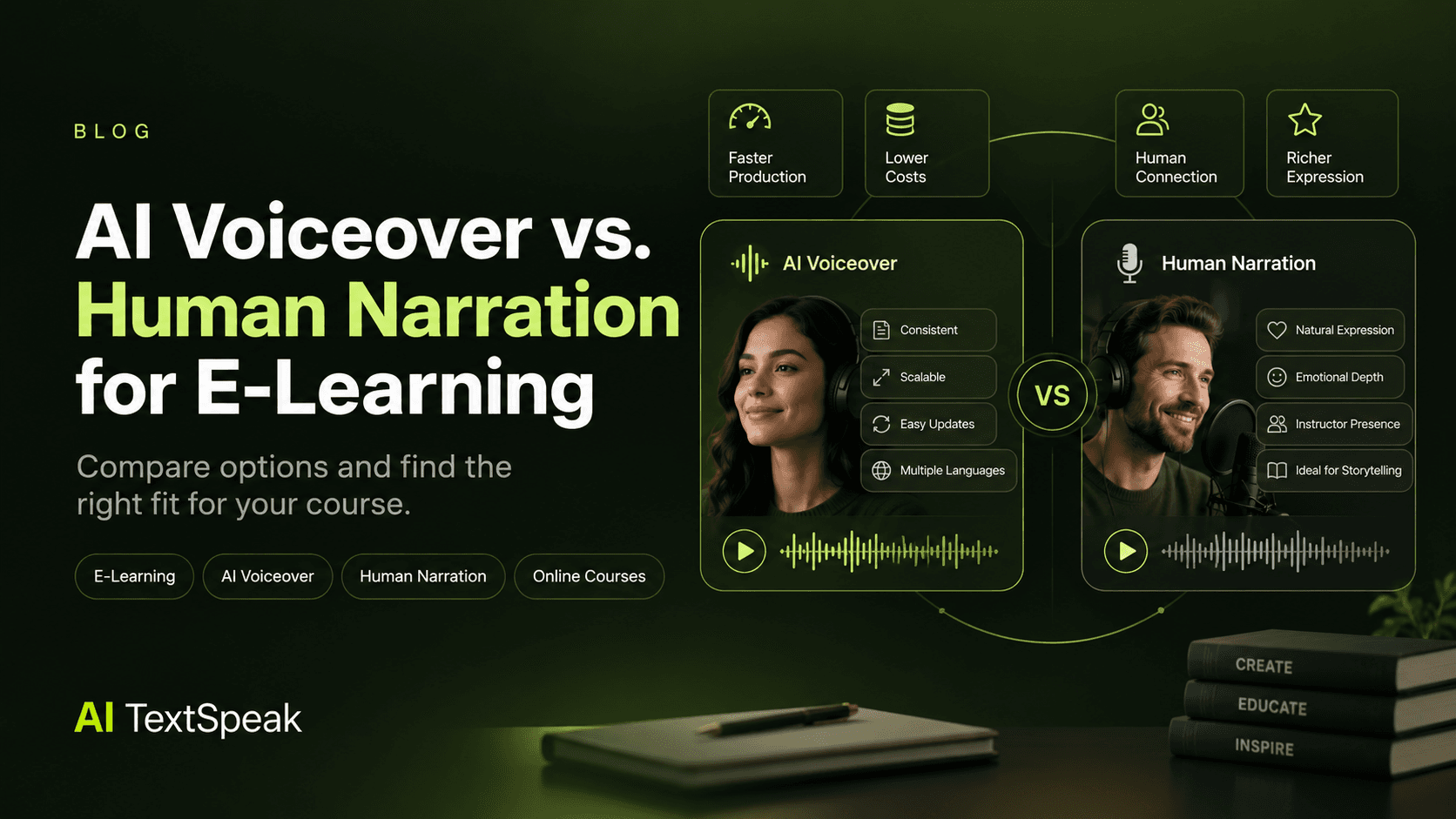
When creating an online course, choosing the right narration can have a major impact on the learning experience. Today, course creators have two main options: record a human narrator or generate the voiceover with AI.
Neither option is automatically right for every course.
Human narration can bring personality, emotion, and a strong sense of instructor presence. AI voiceover can make production faster, easier to update, and more scalable, especially when a course contains many lessons or needs to be localized into multiple languages.
The right choice depends on what your course actually needs.
In this guide, we'll compare AI voiceover vs. human narration for e-learning, including quality, consistency, production speed, updates, scalability, cost considerations, and the types of courses where each approach can work well.
AI Voiceover vs. Human Narration: What's the Difference?
AI voiceover uses text-to-speech technology to transform a written course script into spoken audio using a synthetic voice.
Human narration is recorded by a real voice actor, instructor, or subject-matter expert reading the course script.
Both approaches can produce professional educational content. The difference is mainly in how the narration is produced and what kind of control the course creator has over the final performance.
With human narration, the performance comes from the narrator's interpretation of the script. With AI voiceover, the delivery comes from the selected synthetic voice and the way the script is structured.
AI Voiceover vs. Human Narration at a Glance
| Factor | AI Voiceover | Human Narration |
|---|---|---|
| Production speed | Fast generation and iteration | Requires recording and production time |
| Consistency | Easy to maintain across lessons | Depends on recording conditions and sessions |
| Course updates | Individual sections can be regenerated | Updated sections usually require another recording |
| Scalability | Well suited to large volumes of narration | Requires additional recording resources |
| Performance | Controlled through voice and script selection | Human interpretation and direction |
| Emotional expression | Depends on the selected voice and generation capabilities | Strong control over emotional delivery |
| Multilingual production | Can support localization workflows | Requires appropriate human narrators for each language |
| Production workflow | Primarily script and software based | Requires narrator, recording, and editing workflow |
When AI Voiceover Makes Sense for E-Learning
AI voiceover can be particularly useful when the course depends on speed, consistency, frequent updates, or large amounts of narration.
1. Courses That Change Frequently
Some educational content becomes outdated quickly.
Software tutorials may need to change when an interface is redesigned. Compliance training may change when policies are updated. Product training may need new information after a product release.
With human narration, even a short script change can require another recording session.
With AI voiceover, the updated section can be generated again using the same voice.
2. Large Courses With Many Lessons
A course containing dozens of lessons can require hours of narration.
AI voiceover can make this type of production easier to manage because the narration can be generated from approved scripts without coordinating a recording session for every module.
3. Courses That Need Multiple Languages
International course creators may need to create the same educational material in several languages.
AI voice technology can support this type of localization workflow by allowing creators to generate narration in different languages without recording every version from scratch.
However, each language should still be reviewed for pronunciation, pacing, and naturalness.
4. Internal Training and Corporate Learning
Internal training often contains practical information rather than performance-driven storytelling.
For onboarding, software training, process documentation, and instructional modules, a clear and consistent AI voice can be a practical option.
5. Courses That Need Rapid Production
If a course needs to move from script to finished lesson quickly, AI voiceover can reduce the amount of time spent on recording and revisions.
This can be especially useful when the course creator already has a finished script and needs to turn it into narrated educational content.
When Human Narration Makes Sense for E-Learning
Human narration can be especially valuable when the narrator's personality, performance, or relationship with the audience is an important part of the course.
1. Instructor-Led Courses
If the course is built around a specific instructor, hearing that instructor's real voice can strengthen the connection between the teacher and the learner.
This can be particularly important when the instructor's personality is part of the value of the course.
2. Storytelling and Emotion-Heavy Content
Some courses depend heavily on storytelling, emotional delivery, humor, or nuanced performance.
A professional human narrator can respond dynamically to the meaning of a sentence and make deliberate performance choices based on the context.
3. Personal Brand Courses
Creators who sell courses as an extension of their personal brand may prefer their own voice because the narration is part of the identity of the product.
In these cases, the voice is not simply delivering information. It is part of the relationship between the creator and the learner.
4. Performance-Driven Educational Content
Some educational projects require characters, dramatic dialogue, highly expressive delivery, or frequent changes in emotional tone.
Human performers can be useful when the voice itself is a central part of the experience.
AI Voiceover vs. Human Narration: Quality
Voice quality should not be judged only by how realistic a voice sounds in a short sample.
For e-learning, the more important question is whether the narration remains clear and comfortable throughout an entire lesson.
When evaluating AI voiceover, pay attention to:
- Pronunciation
- Pacing
- Pauses
- Emphasis
- Consistency
- Technical terminology
- Long-form listening comfort
For human narration, quality also depends on the narrator's recording environment, microphone, editing, direction, and ability to maintain a consistent performance across sessions.
In both cases, the final audio should be reviewed before it becomes part of the published course.
AI Voiceover vs. Human Narration: Cost
Cost is another major consideration, but it should be evaluated across the entire production process rather than looking only at the price of the voice itself.
Human narration can involve costs associated with:
- Voice actor fees
- Recording sessions
- Studio time
- Audio editing
- Direction
- Retakes
- Future re-recording sessions
AI voiceover generally shifts more of the workflow toward software and usage-based costs.
This can make AI particularly attractive for courses with large amounts of narration or content that changes frequently.
However, the cheapest option is not always the right option. Consider the value of the narrator's performance, the course's production requirements, and how often the content will need to be updated.
AI Voiceover vs. Human Narration: Course Updates
This is one of the biggest practical differences between the two approaches.
Imagine that a 20-minute training module contains one outdated sentence.
With human narration, you may need to schedule another recording, reproduce the recording environment, record the new line, edit the audio, and replace the old section.
With AI narration, the updated sentence can be generated again using the same voice and inserted into the lesson.
For courses that are updated frequently, this flexibility can make a significant difference to the production workflow.
AI Voiceover vs. Human Narration: Consistency
Consistency matters when learners move through multiple modules.
The narrator should ideally maintain a similar tone, pacing, and pronunciation throughout the course.
AI voiceover can make this easier because the same selected voice can be reused across multiple lessons.
Human narrators can also deliver highly consistent courses, particularly when the project is recorded professionally and produced under controlled conditions. However, maintaining the same performance across separate recording sessions requires careful direction and production.
AI Voiceover vs. Human Narration for Multilingual Courses
Creating a multilingual course introduces another layer of complexity.
With human narration, each language typically requires an appropriate narrator who understands the language, pronunciation, and cultural context.
AI voice technology can simplify the production process by generating versions of a script in multiple supported languages.
However, localization should never be treated as a simple translation-and-generate process. The translated script and generated narration should be reviewed by someone who understands the target language and audience.
What About Learner Experience?
The learner experience should be one of the most important factors in the decision.
A voice that is technically impressive but difficult to listen to for 30 minutes can hurt the experience. Similarly, a human recording with poor audio quality or inconsistent pacing may not create the professional experience you want.
Research comparing AI-generated and human-made teaching videos suggests that the difference is not simply about whether learners can learn from the material. In one experimental study, participants showed a small preference for the human-made videos in terms of learning experience, while learning outcomes were similarly high across the two conditions. :contentReference[oaicite:1]{index=1}
This is why testing the actual learning experience matters more than choosing a technology based on assumptions.
How to Decide Between AI and Human Narration
Instead of asking which technology is universally better, start by identifying the requirements of your course.
Choose AI Voiceover If You Prioritize:
- Fast production
- Frequent content updates
- Consistent narration
- Large volumes of audio
- Multiple language versions
- Flexible production workflows
- Rapid testing and iteration
Consider Human Narration If You Prioritize:
- A specific instructor's voice
- Personal connection
- Highly expressive performance
- Storytelling
- Complex emotional delivery
- Character-based narration
- A strong personal brand experience
And there is also a third option: use both.
Can You Combine AI Voiceover and Human Narration?
Yes. A hybrid approach can make sense for some courses.
For example, a course creator might use their own voice for the introduction, welcome message, and personal sections while using AI voiceover for technical explanations, supplementary modules, or frequently updated material.
Another approach is to use human narration for the core lessons and AI voiceover for drafts, prototypes, internal training, or sections that change frequently.
The best workflow depends on what role narration plays in the course.
How to Test Both Options Before Choosing
If you are unsure which approach fits your course, do not decide based on theory alone.
Choose one representative section of your course and create two versions.
For the AI version:
- Select two or three suitable voices.
- Use the actual course script.
- Check pronunciation and pacing.
- Listen to the complete section.
For the human version:
- Use the same script.
- Give the narrator clear direction.
- Record the same section.
- Review the final edited audio.
Then compare both versions based on the things that actually matter to your course:
- Clarity
- Listening comfort
- Tone
- Consistency
- Production time
- Revision flexibility
- Audience expectations
This small test can reveal much more than comparing voice demos in isolation.
AI Voiceover vs. Human Narration: Frequently Asked Questions
Is AI voiceover as good as human narration for e-learning?
It depends on the course. AI voiceover can work very well for clear, instructional content, while human narration can offer advantages when personality, emotional performance, or instructor presence is central to the course.
Is AI narration cheaper than hiring a voice actor?
AI voiceover can reduce recording and revision costs, particularly for large or frequently updated courses. However, total cost depends on the AI platform, usage, production workflow, and requirements of the project.
Is human narration more engaging?
Not automatically. Engagement depends on the quality of the voice, script, pacing, visuals, and overall course design. Human narration can provide strong personality and emotional performance, while a well-selected AI voice can provide clear and consistent instructional delivery.
Can AI voiceover be used for corporate training?
Yes. AI voiceover can be useful for onboarding, software training, compliance material, internal education, and other instructional content, subject to the licensing terms of the voice platform you use.
Can I update an AI-narrated course easily?
One of the practical advantages of AI narration is that individual sections can be regenerated when the script changes, without requiring a new recording session.
Can I use AI and human narration in the same course?
Yes. A hybrid approach can work when different parts of the course have different narration requirements.
Final Thoughts: AI Voiceover or Human Narration?
There is no universal answer to the AI voiceover vs. human narration question.
For some e-learning projects, the personality and performance of a human narrator will be an important part of the experience. For others, speed, consistency, scalability, and easy updates may make AI voiceover a practical choice.
The best decision starts with the course itself.
Consider how often your content changes, how much narration you need, who your learners are, whether you need multiple languages, and how important the narrator's personal performance is to the course.
Then test both approaches with real course content before committing to the full production.
Ready to Test AI Voiceover for Your E-Learning Course?
If your course needs fast, consistent narration, AI TextSpeak lets you turn written scripts into AI voiceovers and experiment with different voice styles before producing your full course.
Explore our guide to the best AI voices for e-learning or try AI TextSpeak and create your first voiceover.